Falun Gong is a special method of Buddhist-school cultivation, distinguished by features that are different from ordinary Buddhist cultivation practices. Because this practice is a high-level cultivation method, traditionally taught only to individuals with very high xinxing (mind nature) or those with exceptional spiritual potential, it was once difficult to make it widely available. However, in order to help more practitioners improve, understand this cultivation system, and meet the needs of the many people aspiring to cultivate, the practice has been organized into a set of exercises suitable for public teaching. Even so, it already far surpasses the content and level of ordinary qigong practices.
Practitioners of Falun Gong not only develop energy and abilities rapidly, but also, within a short period of time, can cultivate a powerful Falun. Once formed, the Falun rotates automatically at the practitioner’s lower abdomen, continuously drawing in and transforming energy from the universe, which is then converted into gong within the practitioner’s body. This fulfills the principle of “the Law refines the person.”
1.Buddha Stretching a Thousand Arms
The core principle of “Buddha Stretching a Thousand Arms” is stretching and opening, enabling all meridians to become unblocked. For beginners, this exercise allows one to quickly sense qi. For experienced practitioners, it brings rapid improvement. This exercise requires the meridians throughout the entire body to open right from the start, placing the practitioner at a relatively high level as they begin cultivation.
Although the movements of this exercise are simple, the Great Way is extremely simple and easy to practice. Despite their simplicity, the movements control what is cultivated through the entire practice on a macro level. When learning this exercise, practitioners often feel heat throughout the body and experience a strong energy field. This occurs because the exercise opens and unblocks all the qi channels in the body. Its purpose is to break through blockages, achieve full smoothness, and mobilize strong movement of qi both inside the body and beneath the skin, while absorbing large amounts of energy from the universe. It also enables practitioners to quickly enter a state of strong qi and energy flow.
As the foundational exercise of Falun Gong, this exercise is generally practiced first during each session. It is one of the methods of strengthened cultivation.
Formula:
“Body and mind merge into one; movement and stillness follow naturally.”
“Reaching upward with supreme dignity, the Thousand-Hand Buddha stands firm.”
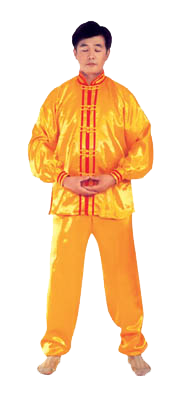
Figure 1-1
Preparation Posture — Relax the whole body, remaining loose but not lax. Stand naturally with the feet shoulder-width apart. The legs are slightly bent, and both the knees and hips remain flexible and relaxed. Gently tuck in the chin, place the tongue against the upper palate, keep the teeth slightly apart, and close the lips. Keep the eyes lightly closed, with a serene expression on the face. During the exercise, one may feel tall and majestic.
Hand Seal — Raise both hands with the palms facing upward. Lightly touch the tips of the thumbs together, while the remaining four fingers of each hand are joined and overlapped. For men, the left hand is on top; for women, the right hand is on top, forming an oval-like shape, and place it at the lower abdomen. Extend the arms slightly forward, and lift the elbows to keep the armpits open (see Figure 1-1).
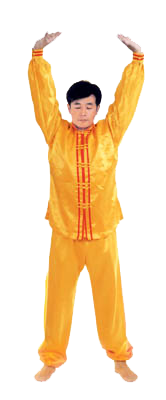
Figure 1-2
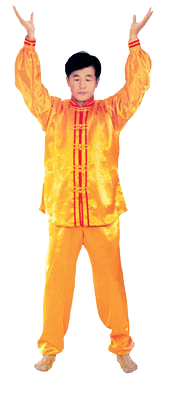
Figure 1-3
Maitreya Stretch — Begin from the Hand Seal posture. Raise the hands along with the hand-seal posture. As the hands lift, gradually straighten the legs. When the hands reach above the head, release the hand seal and slowly turn the palms upward. When the hands reach the top of the head, the palms face upward, with fingers opposite each other and fingertips about 20–25 cm apart (see Figure 1-2). At the same time, lift the head upward, press the feet down, and straighten the body. Push the bases of the palms upward with force, stretching the entire body gradually. Hold the stretch for about 2–3 seconds, then relax completely. Pay special attention to restoring the knees and hips to a flexible, smooth state.
Tathagata’s Blessing — Continue from the previous posture. Rotate both palms outward simultaneously by approximately 140 degrees, forming a “funnel” shape with the hands, extend the wrists, and lower the palms (see Figure 1-3). Let the palms descend in front of the chest, keeping them about 10 cm away from the chest, then continue moving them downward toward the lower abdomen (see Figure 1-4).

Figure 1-4
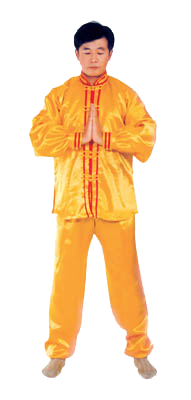
Figure 1-5
Hands Joined in Prayer — After the palms reach the lower abdomen, immediately raise both hands to the chest to join them in a “prayer” position (see Figure 1-5). When joining the hands, press fingers to fingers and the bases of the palms together, keeping a hollow space in the palms. Lift the elbows so that the forearms form a straight line. (Except for the “Prayer” and “Hand Seal” positions, all other hand positions are in the “Lotus Palm” form, as noted below.)

Figure 1-6
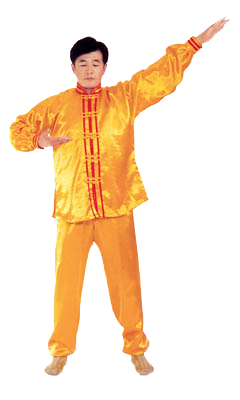
Figure 1-7
Palms Directing Heaven and Earth — Begin from the “Hands Joined in Prayer” posture. Gently separate the palms about 2–3 cm apart and begin to rotate the hands. For men, the left hand (for women, the right hand) rotates toward the chest, while the other hand rotates outward, forming a straight-line position with the forearms: left hand on top, right hand below (see Figure 1-6).
Next, extend the left forearm diagonally upward to the left, palm facing downward, with the hand at roughly the same height as the head. The right hand remains in front of the chest, palm facing upward. As the left hand reaches its position, straighten the body gradually, lift the head, and press the feet downward. Stretch the left hand diagonally upward while keeping the right hand in front of the chest, following the outward extension of the upper arm (see Figure 1-7). Hold the stretch for about 2–3 seconds, then relax completely.
Bring the left hand back in front of the chest to join with the right hand in the “prayer” position again. Then rotate the hands so that the right hand (for women, the left hand) is on top and the left hand is below (see Figure 1-8), and extend the right hand in the same manner as the left: forearm diagonally upward to the right, palm facing downward, hand at head height; the left hand remains in front of the chest, palm facing upward. After stretching (see Figure 1-9), relax the body completely. Finally, bring the hands back together in front of the chest in the “prayer” position (see Figure 1-5).
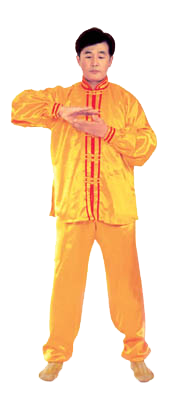
Figure 1-8
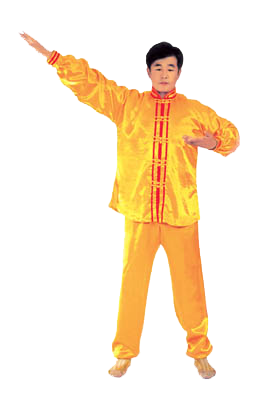
Figure 1-9
Golden Monkey Dividing the Body — Begin from the “Hands Joined in Prayer” posture. Stretch both hands outward from the chest to the sides, forming a straight-line position with the shoulders. Gradually straighten the body, lift the head upward, press the feet downward, and exert force outward with both hands, stretching in all directions (see Figure 1-10). Hold the stretch for about 2–3 seconds, then relax completely. Bring the hands back together in front of the chest in the “prayer” position.
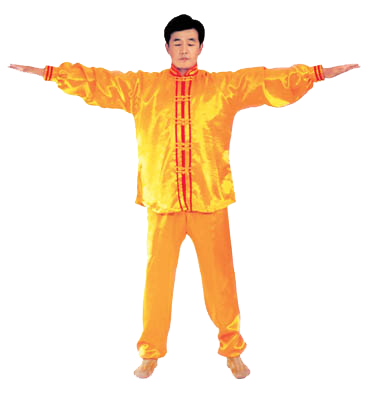
Figure 1-10
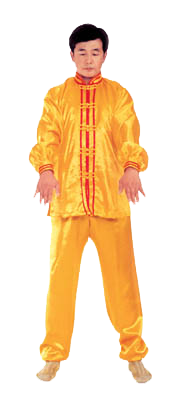
Figure 1-11
Twin Dragons Descend into the Sea — Begin from the “Hands Joined in Prayer” posture. Extend one hand to the side while the other stretches downward and forward. When both arms are fully extended and parallel, the angle between the arms and the thighs is approximately 30 degrees (see Figure 1-11). Gradually straighten the body, lift the head upward, press the feet downward, and hold the stretch for about 2–3 seconds, then relax completely. Bring the hands back together in front of the chest in the “prayer” position.
Bodhisattva Supports the Lotus — Begin from the “Hands Joined in Prayer” posture. Extend one hand to the side while the other stretches diagonally downward alongside the body. When the hands reach the sides, fully extend the arms, forming an angle of approximately 30 degrees between the arms and the thighs (see Figure 1-12). Gradually straighten the body and press the fingertips downward with force. Then, immediately relax completely and bring the hands back together in front of the chest in the “prayer” position.

Figure 1-12
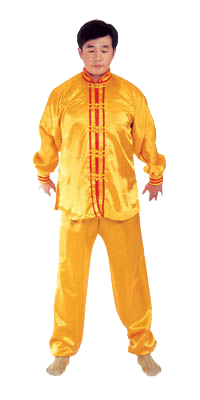
Figure 1-13
Arhat Carrying the Mountain — Begin from the “Hands Joined in Prayer” posture. Extend one hand to the side while the other stretches backward, with both palms rotating to face backward. As the hands reach the sides of the body, gradually bend the wrists; when the hands pass behind the body, the wrists form an approximately 45-degree angle (see Figure 1-13). Gradually straighten the body. Once the hands are in position, lift the head, press the feet downward, and keep the body upright. Hold the posture for about 2–3 seconds, then relax completely. Bring the hands back together in front of the chest in the “prayer” position.

Figure 1-14

Figure 1-15

Figure 1-16
Vajra Pushing the Mountain — Begin from the “Hands Joined in Prayer” posture. Extend one hand forward in a vertical-palm position, fingertips pointing upward, with the arm at shoulder height, while the other hand moves to the side. Once the arm is fully extended, exert force, lift the head, press the feet downward, and keep the body upright (see Figure 1-14). Hold the posture for about 2–3 seconds, then relax completely. Bring the hands back together in front of the chest in the “prayer” position.
Hands Overlapping on the Lower Abdomen — Begin from the “Hands Joined in Prayer” posture. Slowly lower both hands, turning the palms to face the abdomen. When the hands reach the lower abdomen, overlap them: for men, the left hand is underneath; for women, the right hand is underneath, with the palm facing the back of the other hand. Maintain a distance of approximately 3 cm between the hands and between the hands and the abdomen. The overlapping position is generally held for 40 to 100 seconds (see Figure 1-15).
Closing Posture — Form the Hand Seal with both hands (see Figure 1-16).
2.Falun Standing Stance
Principles — This exercise is the second set of Falun Gong exercises and belongs to the static stance (Zhan Zhuang) practices. It consists of four “embracing the Falun” movements, which are relatively simple and repetitive, but each movement requires a long practice time. Beginners often feel heavy and sore in the arms at the start, but after practice, the body immediately feels light, without the fatigue that comes from manual work.
With time and repeated practice, a Falun may be perceived rotating between the arms. Regular practice of the Falun Standing Stance can fully unblock the body’s energy channels and increase one’s gong. The Falun Standing Stance is a comprehensive exercise method that enhances wisdom, raises one’s cultivation level, and strengthens supernatural abilities. Although the movements are simple, what is cultivated is extensive and comprehensive.
The movements should be natural, with the practitioner aware that they are cultivating without unnecessary swaying. Small movements are normal. Like other Falun Gong exercises, no “closing” of energy is required at the end, because the Falun continues to rotate constantly. The length of time for each movement depends on the individual; the longer, the better.
Formula:
“Cultivate wisdom and enhance strength; calm the mind and lighten the body.”
“As if wondrous, as if enlightened, the Falun begins to spin.”
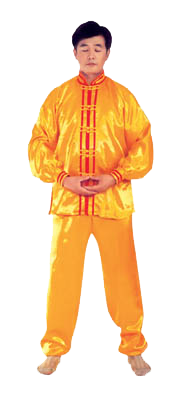
Figure 2-1
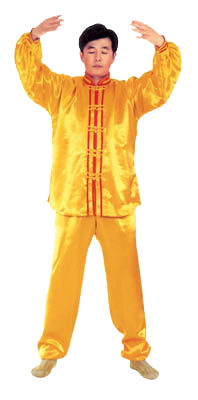
Figure 2-2
Preparation Posture — Relax the whole body, remaining loose but not lax. Stand naturally with the feet shoulder-width apart. Slightly bend the legs, keeping the knees and hips flexible. Gently tuck in the chin, place the tongue against the upper palate, keep the teeth slightly apart, and close the lips. Keep the eyes lightly closed, with a serene expression on the face.
Hand Seal — Form the Hand Seal with both hands (see Figure 2-1).
Embracing the Falun in Front of the Head — Begin from the Hand Seal posture. Slowly raise both hands in front of the abdomen, gradually releasing the hand seal. When the hands reach the front of the head, turn the palms to face the face, keeping them at eyebrow height. The fingertips of both hands face each other, approximately 15 cm apart, with the arms forming a rounded embrace. Keep the whole body relaxed (see Figure 2-2).

Figure 2-3
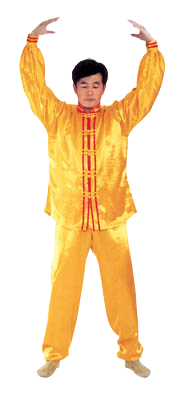
Figure 2-4
Embracing the Falun in Front of the Abdomen — From the “Embracing the Falun in Front of the Head” posture, slowly lower both hands while maintaining the same shape. Lower them to the lower abdomen, keeping a distance of about 10 cm from the abdomen. Lift the elbows so that the armpits remain open, with the palms facing upward. The fingertips face each other, about 10 cm apart, and the arms form a rounded embrace (see Figure 2-3).
Embracing the Falun Above the Head — Begin from the “Embracing the Falun in Front of the Abdomen” posture. Without changing the shape of the arms, slowly raise both hands above the head to perform the overhead embrace. The fingertips face each other, palms downward, with a distance of 20–30 cm between the fingers. The arms form a rounded shape, with the shoulders, arms, elbows, and wrists completely relaxed (see Figure 2-4).
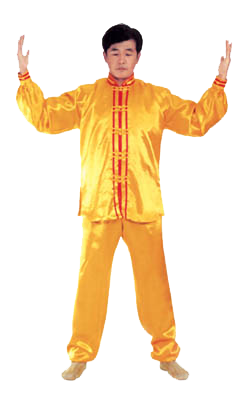
Figure 2-5
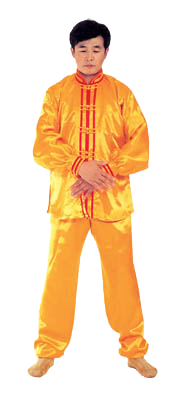
Figure 2-6
Embracing the Falun on Both Sides — From the “Embracing the Falun Above the Head” posture, slowly lower both hands to the sides of the head. The palms face toward the ears, shoulders remain relaxed, and the forearms are vertical. Keep a proper distance between the hands and the ears (see Figure 2-5).
Hands Overlapping on the Lower Abdomen — From the “Embracing the Falun on Both Sides” posture, slowly lower both hands to the lower abdomen to form the overlapping position (see Figure 2-6). Finish by forming the Hand Seal to conclude the exercise.
3.Penetrating the Two Cosmic Extremes
Principles — This exercise is a method for mixing and unblocking the cosmic energy with the body’s internal energy. It involves large-volume breathing, allowing practitioners to expel internal pathogenic and dark energies from the body in a very short time, while simultaneously absorbing abundant cosmic energy to purify the body and advance toward the “Pure White Body” state. At the same time, this exercise can “open the crown” during the energy circulation and also open the energy channels under the feet.
Before Practice — Visualize yourself as two tall, empty cylinders, standing upright, reaching from heaven to earth, immensely tall. Allow the energy within the body to move with the hands: the upward energy rises through the crown of the head to the highest point of the universe, while the downward energy flows out from one foot to the lowest point of the universe. Then, let the energy move with the hands, returning from the two extremes into the body and being emitted again in the opposite direction, repeating this process nine times in total.
During the ninth circulation, the left hand (right hand for women) waits at the upper extreme while the right hand (left hand for women) is raised. Both hands then emit downward energy to the lower extreme and return through the body. After nine round trips, draw the energy back into the body. Once collected, rotate the Falun clockwise at the lower abdomen, drawing external energy back inside. Form the Hand Seal to conclude the practice. As with all Falun Gong exercises, do not “close” the energy at the end of the practice.
Formula:
“Purify the body, with the Falun opening the crown and base.”
“With a compassionate heart and strong intent, reach from heaven to earth.”
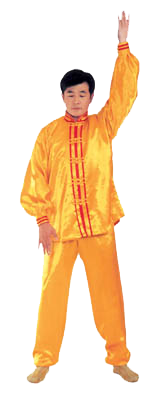
Figure 3-1
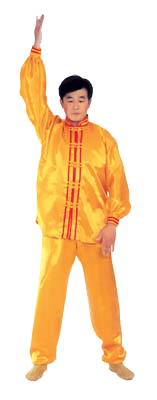
Figure 3-2
Preparation Posture — Relax the whole body, remaining loose but not lax. Stand naturally with the feet shoulder-width apart. Slightly bend the legs, keeping the knees and hips flexible. Gently tuck in the chin, place the tongue against the upper palate, keep the teeth slightly apart, and close the lips. Keep the eyes lightly closed, with a serene expression. Form the Hand Seal and bring the hands together in a “prayer” position.
Single-Hand Energy Circulation — Begin from the “Hands Joined in Prayer” posture. Perform the single-hand upward and downward energy movement, with the hand moving slowly along the external energy flow and the internal energy moving with the hand. For men, begin with the left hand rising (see Figure 3-1); for women, begin with the right hand. Slowly move the hand upward from the front-side of the head, sending energy out through the crown. At the same time, the other hand (right hand for men, left hand for women) slowly sends energy downward. Then switch the upward and downward hands (see Figure 3-2). Keep the palms facing the body, maintaining a distance of about 10 cm from the body. Relax the whole body during the practice. One upward and one downward movement counts as one cycle, and a total of nine cycles are performed.

Figure 3-3

Figure 3-4
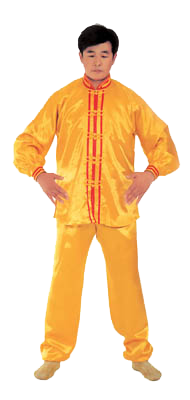
Figure 3-5
Double-Hand Energy Circulation — When the single-hand energy circulation reaches the ninth cycle, with the left hand (right hand for women) at the upper position, raise the other hand so that both hands are in the upward position (see Figure 3-3). Then, send energy downward simultaneously with both hands (see Figure 3-4). Keep the palms facing the body, maintaining a distance of about 10 cm from the body. One upward and one downward movement counts as one cycle. Perform a total of nine cycles.
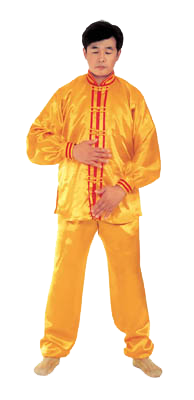
Figure 3-6
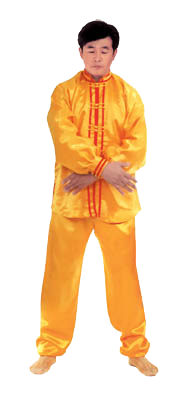
Figure 3-7
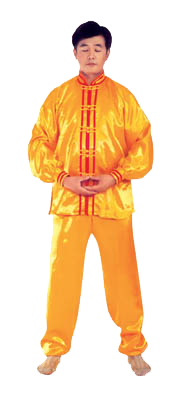
Figure 3-8
Double-Hand Falun Rotation — After completing the ninth cycle, lower both hands from above the head, passing in front of the head and chest, down to the lower abdomen to rotate the Falun (see Figures 3-5, 3-6, 3-7). For men, the left hand is underneath; for women, the right hand is underneath. Maintain a distance of approximately 4 cm between the hands and between the hands and the lower abdomen. Rotate the Falun clockwise four times, drawing external energy back into the body. During the rotation, the hands should remain within the lower abdomen area.
Hand Seal — Form the Hand Seal with both hands (see Figure 3-8).
4.Falun Cosmic Orbit
Principles — This exercise enables a large-scale circulation of energy throughout the body. Unlike exercises that focus on a single meridian or a few channels, the energy flows from the entire yin side of the body to the yang side, continuously circulating back and forth. This goes far beyond ordinary meridian-opening exercises or the small and large Zhou Tian (micro- and macrocosmic circulation).
This exercise is a mid-level practice in Falun Gong. Based on the first three sets of exercises, practicing this method can quickly open all the body’s energy channels, including the Great Zhou Tian, gradually connecting the entire body from top to bottom.
The main feature of this exercise is using the rotation of the Falun to correct improper states within the body, restoring the body’s microcosm to its original condition and achieving unobstructed energy flow throughout the body. Reaching this state represents a high level of cultivation within worldly practices, and practitioners with strong roots may then advance to higher stages of Falun Dafa practice. During practice, the hands move with the flow of energy, and all movements should be gentle, slow, and circular.
Formula:
“Rotate the Falun to emptiness, with the mind as clear as jade.”
“Return to the original and true state, rising gently and calmly.”
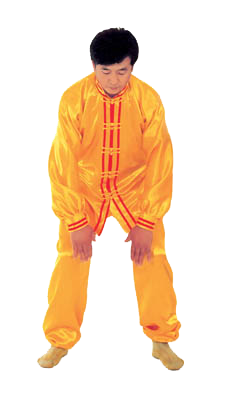
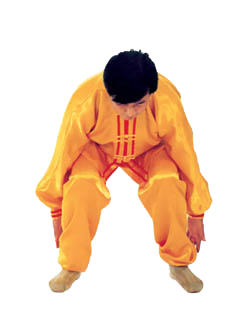
Figure 4-1
Figure 4-2
Preparation Posture — Relax the whole body, remaining loose but not lax. Stand naturally with the feet shoulder-width apart. Slightly bend the legs, keeping the knees and hips flexible. Gently tuck in the chin, place the tongue against the upper palate, keep the teeth slightly apart, and close the lips. Keep the eyes lightly closed, with a serene expression on the face.
Form the Hand Seal and bring the hands together in a “prayer” position.
Lowering the Hands — Simultaneously release the “prayer” position with both hands while lowering them toward the lower abdomen. Rotate the palms to face the body, keeping a distance of approximately 10 cm from the torso. Continue lowering the hands past the lower abdomen, moving along the inner sides of the legs while bending the waist and squatting (see Figure 4-1). When the fingertips approach the ground, the hands trace from the tips of the toes along the outer sides of the feet to the back of the heels (see Figure 4-2).
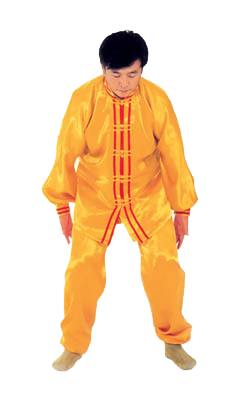

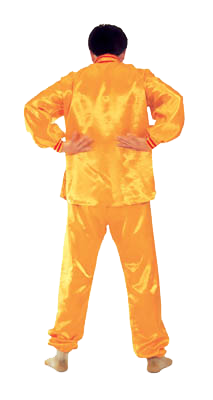
Figure 4-3
Figure 4-4
Figure 4-5

Figure 4-6
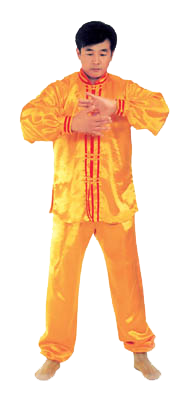
Figure 4-7
Raising the Hands Along the Legs and Upper Body — Gradually lift both hands along the back of the legs from the heels, keeping the wrists slightly bent (see Figure 4-3). One hand rises from behind the back while simultaneously straightening the waist (see Figure 4-4). During the entire Falun Energy Circulation exercise, the hands should not touch any part of the body, as this would cause the energy in the hands to return to the body.
When the hands reach the highest point possible, form empty fists (see Figure 4-5), then bring them through the armpits so that the arms cross at the chest. Which arm is on top is left to personal preference; there is no distinction between men and women (see Figure 4-6). Release the fists so that the palms rest on the shoulders with a slight gap.
Next, slide both palms along the yang side of the arms down to the wrists, turning the palms to face each other: the outer hand’s thumb points upward, and the inner hand’s thumb points downward, with a distance of approximately 3–4 cm between the palms. The hands and arms now form a straight-line “I” shape (see Figure 4-7).
Then, perform the “grasping the ball and twisting the palms” movement, switching the positions of the inner and outer hands. Continue by moving the hands upward along the yin side of the forearms and upper arms, lifting them over the head (see Figure 4-8). After passing over the head, cross the hands and continue moving toward the Dazhui point at the upper spine (see Figure 4-9).
Separate the crossed hands, pointing the fingertips downward to connect with the energy along the back. Then move the hands parallel from above the head to the chest (see Figure 4-10). This completes one full Zhou Tian (energy circulation). Repeat the entire cycle nine times. After the ninth cycle, lower both hands from the chest down to the lower abdomen.
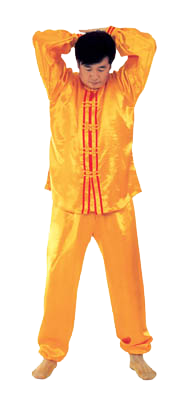
Figure 4-8
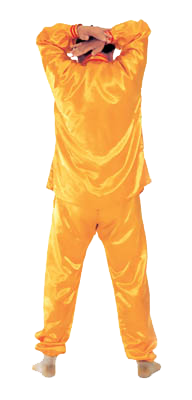
Figure 4-9
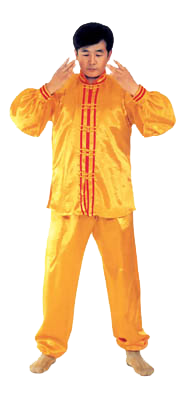
Figure 4-10
Stacking the Hands on the Lower Abdomen — Place one hand over the other on the lower abdomen (men: left hand inside; women: right hand inside), then form the Hand Seal.
5.Strengthening Divine Powers
Principles — The “Divine Power Empowering Method” is a seated, meditative practice of Falun Gong. It uses the “Buddha” hand seal to rotate the Falun and empower both spiritual abilities (including functions) and cultivation skill through multiple related exercises. This is a mid- to advanced-level practice, originally a secret method. To meet the needs of practitioners with a certain foundation, this method has been transmitted to enable those with affinity to receive it.
This exercise is practiced in a seated position, preferably in full lotus (double lotus), though single-lotus posture is also acceptable. During practice, the energy flow is strong, and the external energy field is large. Movements follow the energy guidance from the Master, beginning with the mind moving in accordance with intention.
When empowering divine abilities, the mind is empty, with the subconscious slightly present in the palms. Practitioners may feel heat, weight, tingling, or a sense of something in the palms. However, one should not intentionally pursue these sensations; allow them to arise naturally. The longer one sits, the stronger the effect; duration may vary according to the practitioner’s level, with longer practice yielding greater strength and faster results.
During practice, the mind is gradually emptied of all thoughts, entering a meditative state from what seems like a dynamic yet non-fixed movement, eventually reaching a settled state, while the main consciousness remains aware of the practice.
Formula:
“With or without intention, the hand seals arise spontaneously.”
“Seemingly empty yet not empty, movement and stillness follow the mind’s intention.”
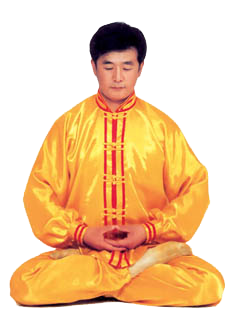
Figure 5-1

Figure 5-2
Form the Hand Seal — Sit in a cross-legged posture, fully relaxing the body while remaining alert. Keep the waist straight and the neck upright. Gently tuck in the chin, place the tongue against the upper palate, keep the teeth slightly apart, and close the lips. Eyes are lightly closed, the mind cultivates compassion, and the face maintains a serene expression. Place both hands in the “Hand Seal” position over the lower abdomen and gradually enter a meditative state (see Figure 5-1).
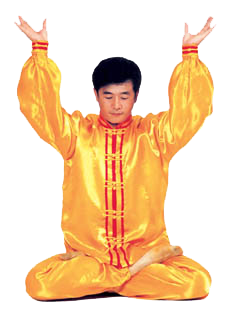

Figure 5-3
Figure 5-4
Hand Seal One — At the start, let the mind move with intention, following the energy flow imparted by the Master. Movements should be slow, gentle, and circular. Gradually lift both hands from the Hand Seal position. When the hands reach in front of the head, slowly rotate the palms upward so that when the palms face upward, the hands have reached the highest point (see Figure 5-2).
Next, separate the hands and trace an arc over the head, moving toward the sides until reaching the front of the head (see Figure 5-3). Then, lower the hands slowly, keeping the elbows close to the body, with the palms facing upward and fingertips pointing forward (see Figure 5-4).
Afterward, extend the wrists while crossing the hands in front of the chest. For men, the left hand passes outside; for women, the right hand passes outside (see Figure 5-5). When the hands cross in a straight “I” formation, rotate the outer hand’s wrist outward while turning the palm upward, tracing a large half-circle so the palm faces upward and the fingertips point backward, applying gentle force. The inner hand, after crossing, gradually rotates the palm downward until fully extended, with the hand and arm forming an angle of approximately 30° from the body in the forward-diagonal direction, with the palm facing outward (see Figure 5-6).
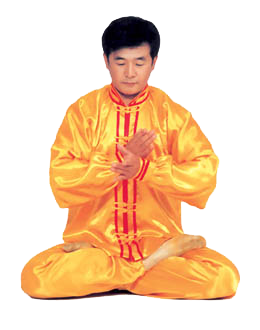
Figure 5-5

Figure 5-6
Hand Seal Two — Starting from the posture in Figure 5-6, the left hand (the upper hand) moves inward while the right hand simultaneously rotates the palm inward and rises. This movement is simply a reversal of Hand Seal One, with the positions of the hands exchanged (see Figure 5-7).
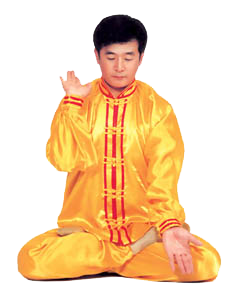
Figure 5-7
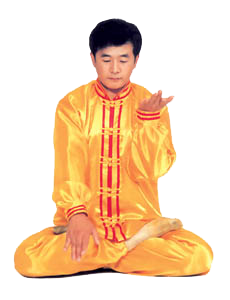
Figure 5-8
Hand Seal Three — For men, extend the right wrist (for women, the left wrist) with the palm facing the body. After crossing in front of the chest, rotate the palm downward until it reaches the front-diagonal lower leg area, keeping the arm straight. Meanwhile, the other hand (men: left hand; women: right hand) rotates the palm inward and rises. After crossing, rotate the palm while moving toward the front of the left (for women, right) shoulder. When the hand reaches its position, the palm faces upward and the fingertips point forward (see Figure 5-8).
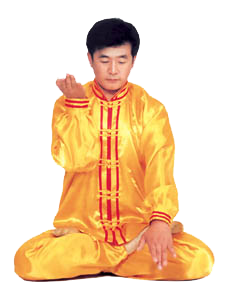
Figure 5-9
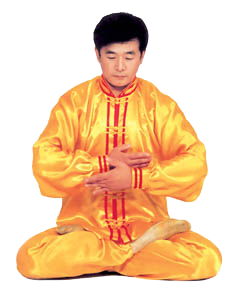
Figure 5-10
Hand Seal Four — This is simply a reversal of Hand Seal Three. For men, the left hand moves inside and the right hand moves outside; for women, the right hand moves inside and the left hand moves outside. The movement is a direct exchange of positions from Hand Seal Three (see Figure 5-9). The first four hand seals are performed continuously without pause.
Empowering Spherical Divine Ability — Begin from Hand Seal Four. The upper hand moves inside while the lower hand moves outside. For men, gradually rotate the right hand so that the palm faces downward toward the chest. The left hand (for women, the right hand) rises. When the forearms reach the chest in a straight “I” formation (see Figure 5-10), stretch both hands outward while simultaneously turning the palms downward. When the hands reach above the outside of the knees, the hand height aligns with the waist, the forearms and wrists remain level, and both arms are relaxed (see Figures 5-11 and 5-12).
This posture channels the practitioner’s internal divine energy into the hands, forming a spherical field of empowerment. During this practice, sensations such as heat, weight, tingling, or a sense of something in the palms may be felt. Do not intentionally pursue these sensations; allow them to arise naturally. The longer this posture is held, the stronger the effect, continuing until it is no longer possible to maintain.
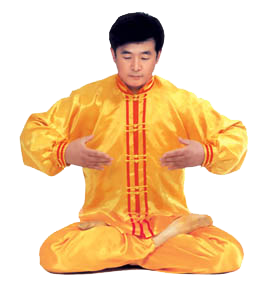
Figure 5-11

Figure 5-12
Empowering Columnar Divine Ability — Continue from the previous posture. The right hand (for women, the left hand) rotates the palm upward while moving toward the lower abdomen. Once in position, the palm faces upward at the lower abdomen. Simultaneously, the left hand (for women, the right hand) rises while moving downward toward the lower chin, with the palm facing downward. The hand height aligns with the lower chin, and the forearm and hand remain level. At this moment, the palms face each other, forming a fixed posture (see Figure 5-13). This is the columnar divine ability, similar to an “energy palm” effect. Hold this posture until it is no longer possible to maintain.
Then, the upper hand traces a half-circle from the front and descends to the lower abdomen. At the same time, the lower hand rises while turning the palm downward, reaching the lower chin (see Figure 5-14). Arms are level with the shoulders, and the palms face each other. This is also a columnar divine ability posture, with reversed hand positions. Continue holding until the arms are fatigued and cannot maintain the posture.
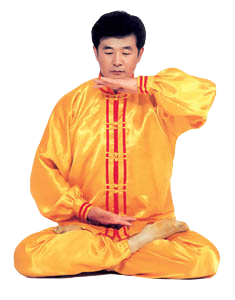
Figure 5-13

Figure 5-14
Static Cultivation — Continuing from the previous posture, the upper hand traces a half-circle from the front and descends to the lower abdomen, with both hands forming the Hand Seal position (see Figure 5-15), entering static cultivation. Gradually settle into a meditative state. The longer this posture is held, the better.

Figure 5-15
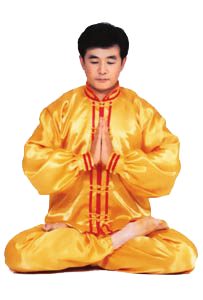
Figure 5-16
Closing Posture — Bring both hands together in the “Prayer” position (see Figure 5-16), exit the meditative state, and release the seated posture.
Basic Requirements and Precautions for Practicing Falun Gong
1. The Five Exercises of Falun Gong
The five exercises of Falun Gong can be practiced in sequence or individually, in any order. However, it is generally recommended to start with the first exercise, and it is advisable to practice it three times. Of course, it is also acceptable to begin with the other exercises without practicing the first one. Each exercise can be practiced independently.
2. Accuracy and Flow of Movements
Movements should be precise and clear in rhythm, with the hands and arms moving smoothly. Whether moving up and down, forward and backward, or side to side, all motions should follow the principle of being gentle, slow, and circular, guided by the flow of energy. Avoid moving too quickly or too slowly.
3. Conscious Control During Practice
During practice, one must use the primary consciousness to control oneself. Falun Gong cultivates the primary consciousness, so practitioners should not intentionally pursue body movements. If any unintentional movements occur, they should be controlled, and if necessary, the eyes can be opened to help maintain stability.
4. Full Body Relaxation
The entire body should be relaxed, especially the knees and hips. Standing too stiffly can obstruct the flow of energy through the body’s channels.。
5. Relaxed and Natural Movements
During practice, movements should be relaxed, natural, and graceful, combining softness with firmness. They should flow smoothly and continuously, exerting a certain degree of strength without being stiff or rigid. Practicing in this way enhances the effectiveness of the exercises.
6. Closing the Exercise
At the end of each practice session, “only close the posture, do not stop the energy.” Simply perform the “hands in mudra” posture to close the practice. Once the mudra is completed, the closing is finished. Do not use the mind to stop the energy, because the Falun continues to rotate constantly and cannot be stopped.
7. Practice for the Sick or Weak
Those who are chronically ill or physically weak may practice less frequently or choose only one exercise according to their condition. If it is difficult to perform the dynamic exercises, sitting meditation can be practiced instead. In general, practice should not be interrupted for long periods.
8. Practice Environment
There are no specific requirements for the location, time, or direction of practice. However, the practice area should be clean, and the environment should be quiet.
9. Focus During Practice
When practicing this cultivation method, do not introduce other thoughts or intentions, as this will prevent deviations. Do not combine it with other exercises. If other methods are mixed in during practice, the Falun may become distorted.
10. Settling the Mind
If you find it difficult to calm the mind during practice, you can recite the Master’s name. Over time, this will naturally help you enter a state of calm.
11. Encountering Challenges During Practice
During practice, you may encounter various challenges or tribulations. These are a way of repaying karma. Everyone has karma, so when physical discomfort arises, do not assume it is illness. These tribulations help clear obstacles for cultivation. They may come quickly or in advance, to remove karma and smooth the path of practice.
12. Sitting Posture for Meditation
If you cannot cross your legs while meditating, you may sit at the edge of a chair to practice, which will still be effective. However, as a practitioner, you should be able to cross your legs eventually. With time and regular practice, you will gradually be able to sit in the full cross-legged position.
13. How to Deal with Visual or Interference Phenomena During Meditation Practice
If you see images or hallucinations during meditation, do not pay attention to them; continue practicing. If you feel afraid or threatened in any way, immediately silently recite:
"I have Master Li Hongzhi protecting me; I am not afraid of anything."
Or recite Master Li's name, and then continue practicing.
Source: Official Falun Dafa Website (falundafa.org)